Federal funding to support energy system recovery and modernization in Puerto Rico has been provided by the Federal Emergency Management Agency (FEMA), U.S. Department of Housing and Urban Development (HUD), and other agencies and departments.
LUMA and Genera have presented spending plans to maintain and repair assets that have an impact on reliability and adequacy. Even with system degradation, the full implementation of the 2025 PREPA Fiscal Plan would address the majority of needs of Puerto Rico’s electric system, improving 2024 reliability metrics by nearly 50%.
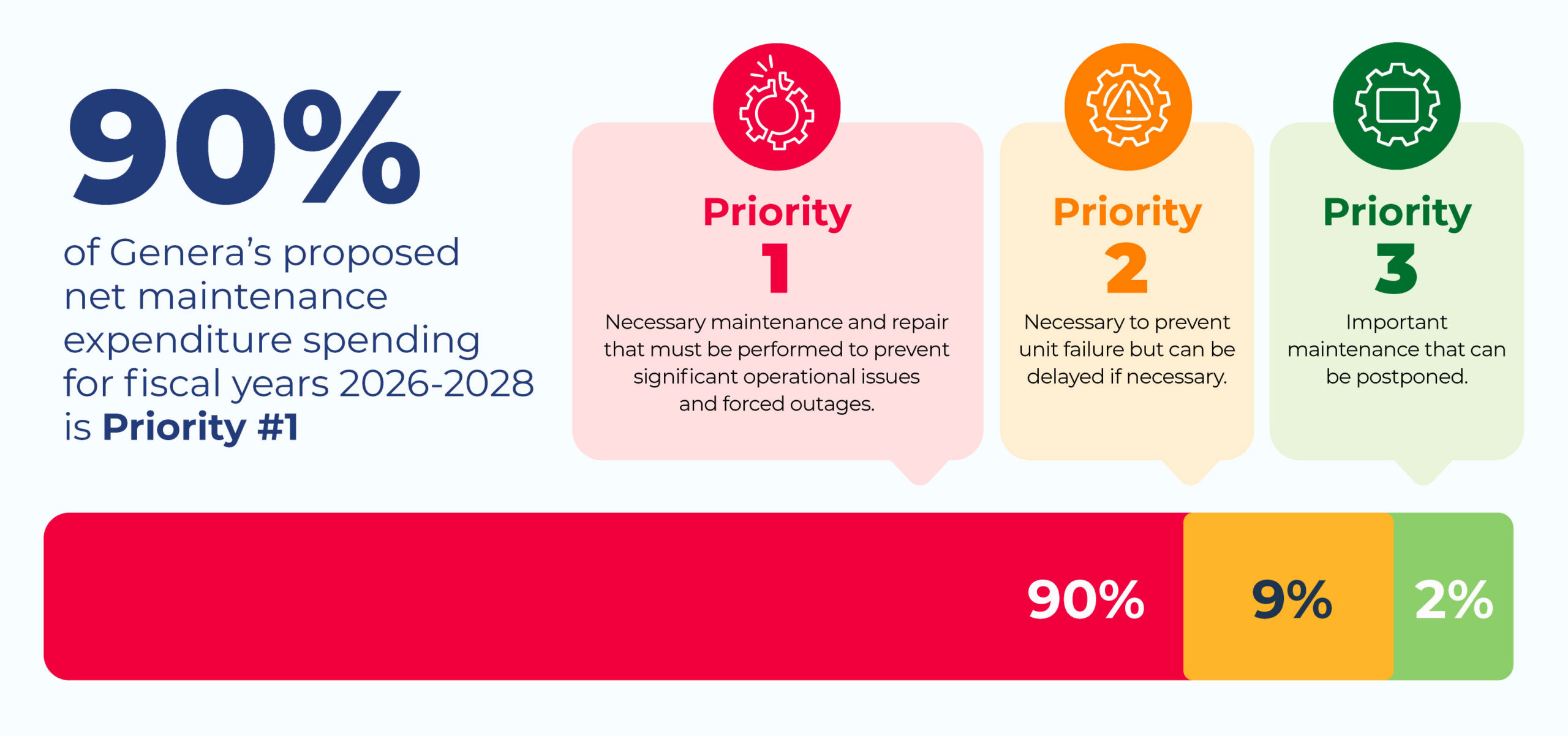
Critical maintenance dominates Genera’s proposed spending plan. Due to aging assets, necessary maintenance and repair activities cannot be further delayed.
In Puerto Rico, FEMA funds are managed by the Central Office for Reconstruction, Recovery and Resiliency (COR3): Public Assistance, Hazard Mitigation Assistance, and Building Resilient Infrastructure and Communities. FEMA also provides funds to support individual assistance as well as additional administration and operations, which are not managed by COR3. More information is available on COR3’s Transparency Portal Recovery Programs page.
The graphics and table below provide a summary of federal funding for energy-system recovery projects related to Hurricane Maria only, including hazard mitigation funding.
FEMA describes hazard mitigation assistance as funding for eligible long-term solutions that reduce the impact of disasters in the future. The graphics and table include the total number of projects submitted and approved, as well as the amount of funding allocated and obligated for these projects.
The table below provides a summary of federal funding for energy-system recovery projects related to series of recent natural disasters in Puerto Rico, and permanent work of the energy system.
The table below shows FEMA funding allocated, obligated, and disbursed by disaster (as of September 10, 2025). (This table does not include hazard mitigation funding, which is provided only for Hurricane Maria and is detailed in the table above showing Hurricane Maria related recovery funding.)
Federal funding for emergency recovery and restoration work is provided for eligible costs incurred to repair infrastructure damage from federally declared disasters or recognized emergencies. Permanent work funding is provided for eligible and approved projects to repair, restore, or replace a disaster-damaged facility and mitigate potential damage from a future disaster or emergency.
| Recent disasters | Obligated amount | Disbursed amount |
| Hurricane Irma | $12,926,737 | $12,926,751 |
| Hurricane Maria | $13,351,065,104 | $4,827,961,910 |
| 2020 Earthquake | $377,892,481 | $359,102,160 |
| COVID-19 | $3,340,513 | $3,340,512 |
| Hurricane Fiona | $195,110,188 | $154,042,854 |
| Total | $13,940,335,023 | $5,357,374,187 |
HUD provides flexible grants to help cities, counties, and states recover from disasters, especially in low-income areas. HUD funding to support energy system recovery in Puerto Rico is provided through HUD’s Community Development Block Grant (CDGB) Disaster Recovery (DR) and Mitigation (MIT) programs.
CDBG-DR Energy includes a separate fund for Electrical System Enhancements which supports two primary programs:
Within the CDBG-MIT program, energy-focused programs include:
HUD CDBG-DR and CDBG-MIT funding for Puerto Rico is managed by the Puerto Rico Department of Housing (Vivienda). More information about CDBG-DR and CDBG-MIT funding and programs for Puerto Rico is available on COR’s Transparency Portal Programs page.
In February 2023, DOE’s Grid Deployment Office launched the Puerto Rico Energy Resilience Fund (PR-ERF) to support grid resilience efforts and help the Commonwealth meet 100% of its electricity generation with renewable sources by 2050 (per Act 17-2019 and Act 1-2025). The PR-ERF is managed by the Grid Deployment Office in consultation with FEMA and HUD, and is being developed in consultation with local entities and communities to increase energy resilience and reduce the energy burden of vulnerable residents.
In February 2024, DOE launched the Solar Access Program to connect low-income Puerto Rican households with subsidized residential solar and battery storage systems. This initiative is funded through Topic Area 1 of the PR-ERF FOA. Learn more about the Programa Acceso Solar.
In May 2025, the U.S. Department of Energy (DOE) announced it will direct $365 million in funding to address Puerto Rico’s grid resiliency and secure power supply through the Puerto Rico Resilience Fund (PR-ERF). The funding will be deployed to support practical fixes and emergency activities that support the stabilization of the electrical system in Puerto Rico.
U.S. Secretary of Energy Chris Wright also issued two emergency orders for Puerto Rico, directing PREPA to dispatch generation units necessary to expand baseload generation and maintain grid reliability, and to perform vegetation management.
Additional sources of federal funding for energy system recovery and modernization include the U.S. Environmental Protection Agency’s (EPA’s) Solar for All program which is part of the Greenhouse Gas Reduction Fund; and the U.S. Department of Agriculture’s Rural Energy for America Program (REAP) and Powering Affordable Clean Energy (PACE) program, which are part of the Inflation Reduction Act.
Learn about these funding sources and status by visiting the following websites and specific pages.